 Edge of the World Riyadh Tours
Is the Edge of the World Near Riyadh Safe? An Honest Answer
Is the Edge of the World Riyadh safe? No authority publishes an incident count or a rate for this site, so anyone offering you a number is making it up. What is real and checkable: the rim is unfenced along its entire length, the rock is brittle limestone, and the genuine risks are environmental rather than criminal, falls, heat, getting lost after dark and a vehicle breakdown with no recovery service and patchy signal. It is not for everyone: operators publish real exclusions for age, pregnancy, back problems and heart conditions, and this guide lays out exactly what they are.
Quick answer
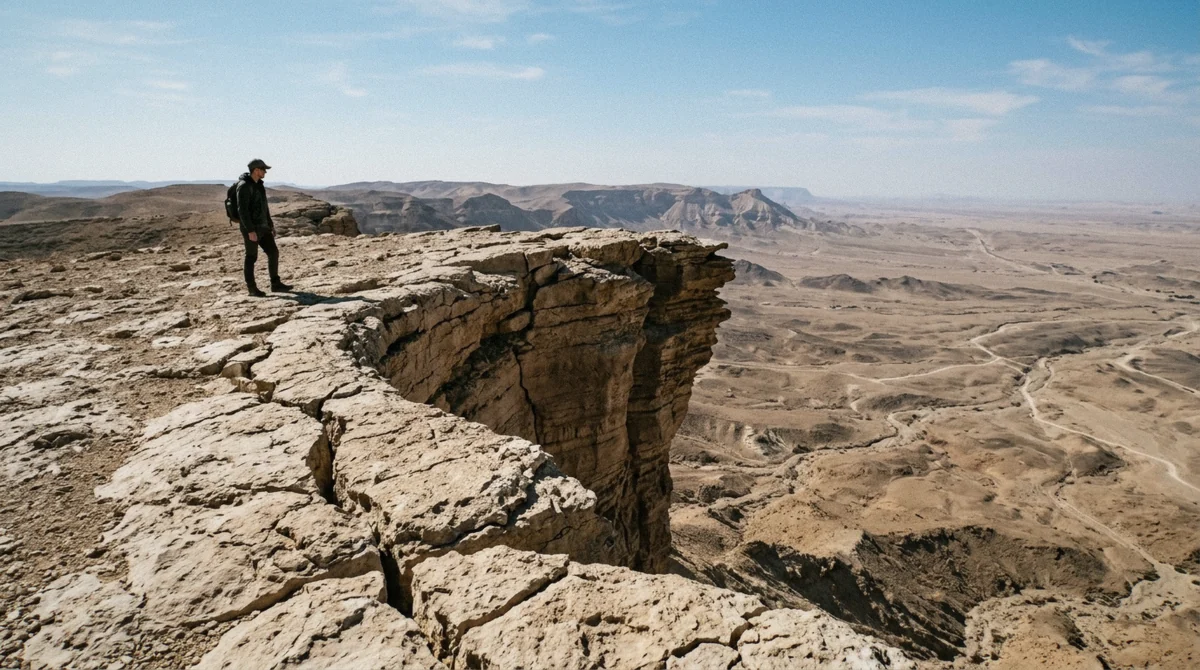
No government body or tourism authority publishes accident statistics specific to the Edge of the World, so this guide will not invent a figure. The genuine risks are a sheer, unfenced drop of roughly 300 metres, brittle limestone at the lip, getting disoriented in featureless desert after dark, and vehicle trouble in an area with no recovery service and unreliable phone signal. It is not risk-free and it is not for everyone.
Key takeaways
- No published incident data exists for this site: treat any number you see elsewhere as unverified
- The rim has no fences, railings or marked paths anywhere along it
- Guides advise staying 1 to 2 metres back from the lip at all times
- Two of the compared operators won't sell to travellers over 70; others exclude pregnancy, back problems, heart conditions or wheelchair users
- Vetting the operator is your biggest safety lever: compare the Edge of the World tours
- Full restriction table below if you or someone you're travelling with has a condition that might matter
Is Riyadh Itself Safe, or Just the Cliff?
These are two different questions, and this post only answers one of them.
Two separate questions
"Is the Edge of the World safe" and "is Riyadh safe to visit" sound like the same question, but they aren't. This page covers activity-level safety at one specific cliff: the rim, the drive, the terrain. It does not attempt a verdict on Riyadh's or Saudi Arabia's general safety for visitors, crime rates, political stability, that's outside what a tour-comparison page can responsibly assess.
For that question, check your own government's official travel-advisory service (the US State Department's four-level system or the UK FCDO's country pages are the standard references) rather than a blog's opinion, then come back here for the parts specific to this trip.
The Short Answer: What the Risk Actually Is
Separated by type, because "is it safe" bundles several different questions into one.
The kinds of safety, separated
Visitor safety: the unfenced rim and loose limestone are the main physical hazard, covered in full below. Wildlife or activity safety: this is a dry desert plateau with no dangerous wildlife encounter typical of the trip, the standard advice is simply not to put hands or feet where you can't see. Driving and transport safety: the desert track is unmarked, phone signal drops in patches, and there's no recovery service, a real factor for tour vehicles and anyone driving themselves alike.
Health safety: heat in the warmer months and cold after sunset in winter are the two ends of the same risk, exposure, with no shade or shelter anywhere on site. City or destination safety: covered above, it's a separate question from this page's scope.
Emergency numbers and medical care
Saudi Arabia's general emergency number is 911 in Riyadh (999 and 997 also route to police and ambulance in other regions), and every operator carries a phone and a contact number for their own office. The nearest serious medical care is back in Riyadh proper, roughly two hours from the cliff on the return drive, which is the honest reason guides treat prevention, staying back from the edge, carrying enough water, as the real safety plan rather than a fast response time.
Who Should Reconsider
If you have a heart condition or high blood pressure
talk to your doctor first and ask the operator about the exertion level of their specific itinerary before booking
If you're pregnant
several listings exclude pregnancy outright; check the restriction table below before you book any specific tour
If you use a wheelchair
none of the compared tours are wheelchair accessible; there's no accessible alternative at this site currently
If you're travelling solo
guides advise against self-driving out here alone; booking a group tour removes that specific risk
If you're bringing young children
the walk itself is easy, the exposure at an unfenced rim is the real factor, hold hands near the edge
If you're over 70
two of the six compared operators do not sell seats to travellers over 70; check individual listings
The Cliff: Why There Are No Barriers
This is not an oversight. The site is not developed as a tourist attraction in the normal sense.
No fences, no railings, no marked paths
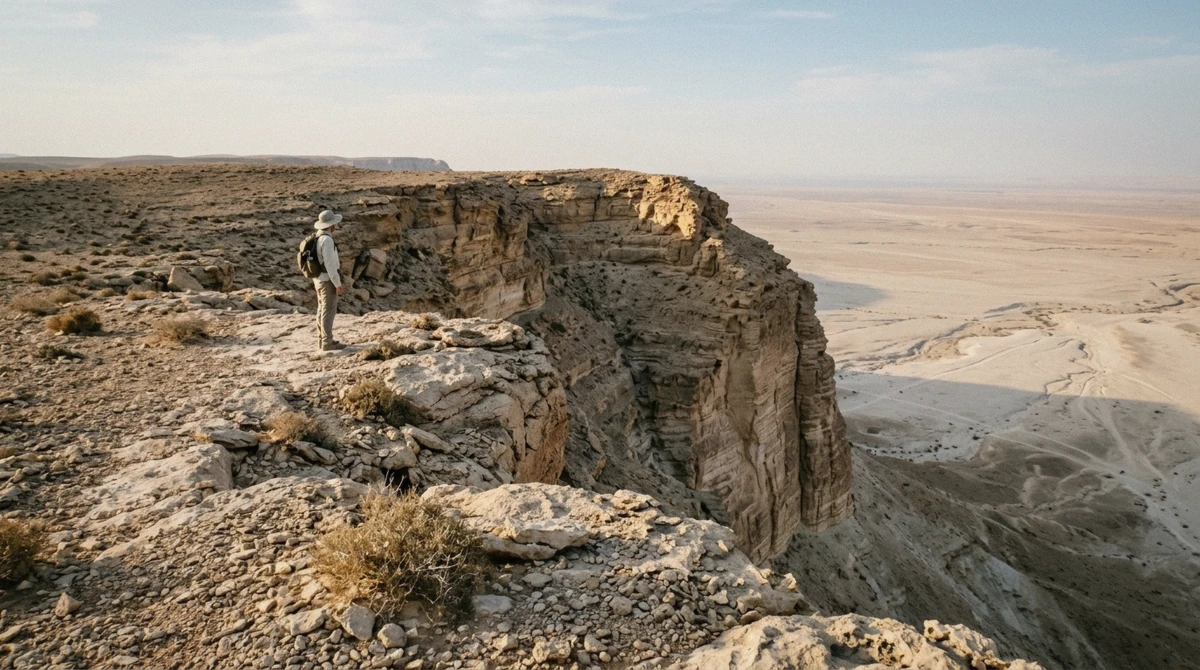
There are no fences, railings or marked paths anywhere along the rim, and the drop is roughly 300 metres. This isn't a maintenance gap at an otherwise developed site, there's no ticket office, no visitor centre and no ranger station either. What you get is raw desert edge, and the responsibility for staying back from it sits entirely with you and your guide.
The rock itself compounds the problem. It's sedimentary limestone, brittle, and guides warn against standing on overhanging ledges since sections have been reported to crumble. The standard guidance is to keep 1 to 2 metres back from the lip at all times, and to never sit with your legs hanging over the edge for a photograph, however tempting the shot looks. Wind off the open plain adds a factor most visitors don't expect: it funnels straight into the escarpment face and can catch you off balance closer to the edge than feels intuitive from a still photo.
Why acknowledging this matters more than reassurance
A page that only says "stay safe, follow your guide" is the evasive operator-speak pattern that doesn't actually help anyone assess the real risk. The honest version is this: an unfenced 300-metre drop on brittle rock is a genuine hazard, full stop, and the mitigation is behavioral rather than structural, because there's no barrier doing the work for you. Guides give a briefing before you're allowed near the rim and mark out the sensible standing spots; that briefing is the actual safety system at this site, not a formality before it.
Getting Lost, Breaking Down and Losing Signal
The risks that make this a genuinely different trip from a fenced, staffed viewpoint elsewhere.
The desert looks the same in every direction
The desert looks identical in every direction and landmarks vanish after sunset; getting disoriented away from the group is a real reported hazard, not a theoretical one. This is why guided groups stay together and why solo exploration off the marked viewpoints is discouraged even for confident hikers, there's no trail to backtrack along once the light goes.
Phone signal drops out on parts of the desert approach, which turns a wrong turn from an inconvenience into a real problem. Guides who run this route weekly know which line through the last stretch is passable; that local knowledge, not equipment, is what keeps groups oriented. Offline maps are the baseline mitigation for anyone attempting this without a guide.
Breaking down where nobody comes
There's no tow service that covers the desert track, and a recovery from deep in the sand is paid by the driver, whether that's a tour operator or someone self-driving. On a guided tour this risk sits with the operator's fleet and experience rather than with you directly, one real advantage of booking rather than driving out independently. Violent crime is not the risk at this site; the risks are environmental, falls, heat, getting lost, vehicle breakdown in an area with no signal and no recovery service, and every mitigation on this page is built around that fact.
Heat, Cold and Water
Exposure, not wildlife or crime, is the health risk that actually applies here.
No shade, ever
There is no shade at any viewpoint. From May to September, daytime temperatures on the plateau pass 40°C (104°F), and standing exposed on rock with no shelter for even thirty minutes is a real heat-exposure risk, which is exactly why the comfortable season for visiting runs October to March. Carry more water than feels necessary, and treat any dizziness or headache on site as a reason to get back to the vehicle immediately rather than pushing through for one more photo.
Cold works the opposite way after dark: winter nights near the cliff sit around 8°C (46°F), a sharp drop from a 20°C (68°F) afternoon, and anyone staying for stargazing without a layer will be genuinely uncomfortable within an hour. Full packing guidance is on the what-to-wear page.
Water and food safety
This isn't a swimming or a wild-water site, so there's no water-quality exposure of the kind a snorkeling trip would carry. Food on the desert dinners, where included, is typically kabsa prepared by the operator's own camp staff, and the practical risk isn't hygiene, it's dietary mismatch: travellers have arrived with a vegetarian note on their booking and found chicken kabsa as the only option served. Confirm any dietary need with the operator directly before the day rather than assuming it will be honoured automatically.
Who Operators Will Not Take
This table is pulled directly from what the six compared operators state on their own listings, not inferred.
Restrictions at a glance
Both a minimum and a maximum matter here: some listings set an age ceiling as well as excluding certain conditions outright. None of the six compared tours is wheelchair accessible, and that's a genuine gap rather than an oversight worth softening.
| Restriction | Typical rule on these tours | Why it exists | Ask before booking if… |
|---|---|---|---|
| Pregnancy | Excluded on some listings, unstated on others | Off-road jolting and the rough walk on the rim | you're pregnant at any stage, confirm with the specific operator |
| Minimum age | Not sold for babies under 1 year on two listings | Long drive time and no facilities for infants | travelling with an infant under one year |
| Maximum age | Not sold to travellers over 70 on two listings | The off-road drive and uneven walking terrain | you or a travel companion is over 70 |
| Heart condition | Excluded on at least one listing | Off-road driving and physical exertion on the rim | you have a diagnosed heart condition |
| Back problems | Excluded on at least one listing | The corrugated off-road stretch shakes the vehicle hard | you have a back injury or recent back surgery |
| Mobility limitations | None of the six are wheelchair accessible | No paved paths, no ramps, uneven natural rock | you use a wheelchair or have significant mobility limits |
| Wheelchair use | Not suitable, stated directly by at least one operator | Same as above, terrain rather than policy | you or anyone in your group uses a wheelchair |
Can you still go with a mobility limitation?
Honestly, not comfortably on any of the six compared listings. The terrain is the limiting factor, not operator policy, natural uneven rock with no paved surface anywhere. If mobility is a concern short of needing a wheelchair, the gazelle sanctuary trip involves the shortest walk of the group at ninety minutes on the rim with a picnic rather than an extended hike.
How to Pick a Safe Operator
The questions and signals that actually separate a well-run tour from a rushed one.
Green flags
A thorough safety briefing before anyone approaches the rim, unhurried boarding rather than a rush to fit one more person into the vehicle, and a guide who visibly marks or points out safe standing spots rather than leaving the group to figure it out. Reviewers of the small-group sunset trip and the gazelle sanctuary trip consistently rate their guides at 4.8 to 4.9, the highest subscores among the six, which tracks with attentive, unrushed groups.
Red flags
A waiver you're asked to sign without being given time to actually read it, a crew saying something like "we'll fit one more in" when the vehicle already looks full, no briefing at all before you're at the rim, or gear that looks mismatched or worn. None of these are hypothetical, they're the standard pattern that separates a careful operator from a careless one across outdoor tourism generally, and this site's exposed terrain makes the difference matter more than it would somewhere fenced.
On valuables: theft isn't the primary risk on a guided group tour with a known driver and a small group, the real exposure point is an unattended bag left at the fuel-station stop or a crowded meeting point before boarding. Keep your phone and cash on you rather than in an unzipped bag, and that covers the practical side of it.
| Situation | Green flag | Red flag |
|---|---|---|
| Before boarding | Unhurried check-in, waiver time to actually read | Rushed signature, no time given |
| Group size | Sticks to the stated small-group size | "We'll fit one more in" when the vehicle looks full |
| At the rim | Clear briefing on the 1 to 2 metre rule before anyone approaches the edge | No briefing at all, group left to work it out |
| Gear and vehicle | Vehicle and safety gear look maintained | Worn or mismatched equipment, unexplained delays |
| Weather calls | Willing to shorten or reschedule for wind or heat | Pushes ahead regardless of conditions |
What If Something Goes Wrong
Three realistic scenarios, and the one lever that's actually in your control.
A vehicle breaks down on the track
What happens: the driver stops, assesses whether the vehicle can continue, and radios or calls the operator's office if signal allows. What the operator does: experienced operators carry basic recovery gear and know the route well enough to judge whether to wait for help or attempt a fix on the spot. What you should do: stay with the group and the vehicle rather than walking off to look for signal or a view, the featureless terrain is exactly where people get disoriented.
Someone gets too close to the edge
What happens: guides intervene immediately, this is the single most enforced rule on every tour. What the operator does: repeats the 1 to 2 metre briefing and, on a well-run tour, physically positions themselves between the group and the more exposed sections. What you should do: treat the guide's instruction as final in the moment, even if the shot you wanted needed one more step forward.
The weather turns, wind or heat spikes
What happens: a well-run tour will shorten time on the rim or reposition the group to a more sheltered viewing spot rather than pushing through. What the operator does: every listing here carries free cancellation up to 24 hours, so a bad forecast is a reason to reschedule rather than go anyway. What you should do: check the forecast the morning of and message the operator if conditions look extreme, most will accommodate a date change.
The one lever you actually control
Across every scenario above, the single biggest factor in your own outcome is which operator you booked with, not luck. A guide who briefs properly, drives carefully and knows the route reduces nearly every risk on this page before it becomes a problem. Disclosing a real medical condition honestly at booking, rather than hoping it won't matter, is the second.
Travel Insurance for This Trip
What actually needs covering, in one short section.
What to check on your policy
Two things matter here: medical and evacuation coverage, given the two-hour drive back to the nearest serious care in Riyadh, and confirmation that off-road vehicle travel and desert excursions aren't on your policy's exclusion list, some standard policies carry blanket adventure-activity exclusions that catch trips like this one even though it isn't extreme in the way skydiving or scuba is. This is about health and injury coverage for the activity itself, not a cancellation or trip-cost refund, which is a separate question from your policy's weather or cancellation terms.
Is It Safe: Common Questions
Are there fences at the Edge of the World?
No. There are no fences, railings or marked paths anywhere along the rim. The drop is roughly 300 metres and the standard guidance is to stay 1 to 2 metres back from the lip.
Is the Edge of the World safe for children?
The walking is easy and short distances between viewpoints; the real factor is an unfenced rim with children nearby. Hold hands close to any edge and treat it the same as you would any clifftop with no barrier.
Is it safe for solo female travellers?
The guided group format itself is the safety factor most travellers rely on here, and it doesn't differ by gender. Guides advise anyone travelling solo, of any gender, against attempting the drive alone rather than joining a group.
What happens if you break down in the desert?
There's no tow service covering the track, and a recovery from deep in the desert is paid by the driver. On a guided tour, that risk sits with the operator's own vehicle and experience; the group stays put and waits for the operator's recovery process rather than walking for signal.
Can you visit if you're pregnant?
Some listings exclude pregnant travellers outright, tied to the rough off-road driving and the uneven walk. Check the specific operator's restrictions before booking rather than assuming.
Is there a weight limit on any of the tours?
None of the compared operators publish a weight limit; the published restrictions cover age, pregnancy, back problems, heart conditions and wheelchair access instead.
Is it safe to bring valuables like a phone or camera?
On a guided group tour with a known driver, theft isn't the main concern; an unattended bag at the fuel-station stop or a crowded meeting point is the real exposure. Keep valuables on you rather than in an open bag.
Safe for most people who go, genuinely not for everyone, and the honest answer sits somewhere between the marketing brush-off and the news-story panic. Pick an operator with a real safety briefing, disclose any condition that might matter, and treat the 1 to 2 metre rule as non-negotiable, and the trip is what most people describe it as afterwards: memorable rather than risky.